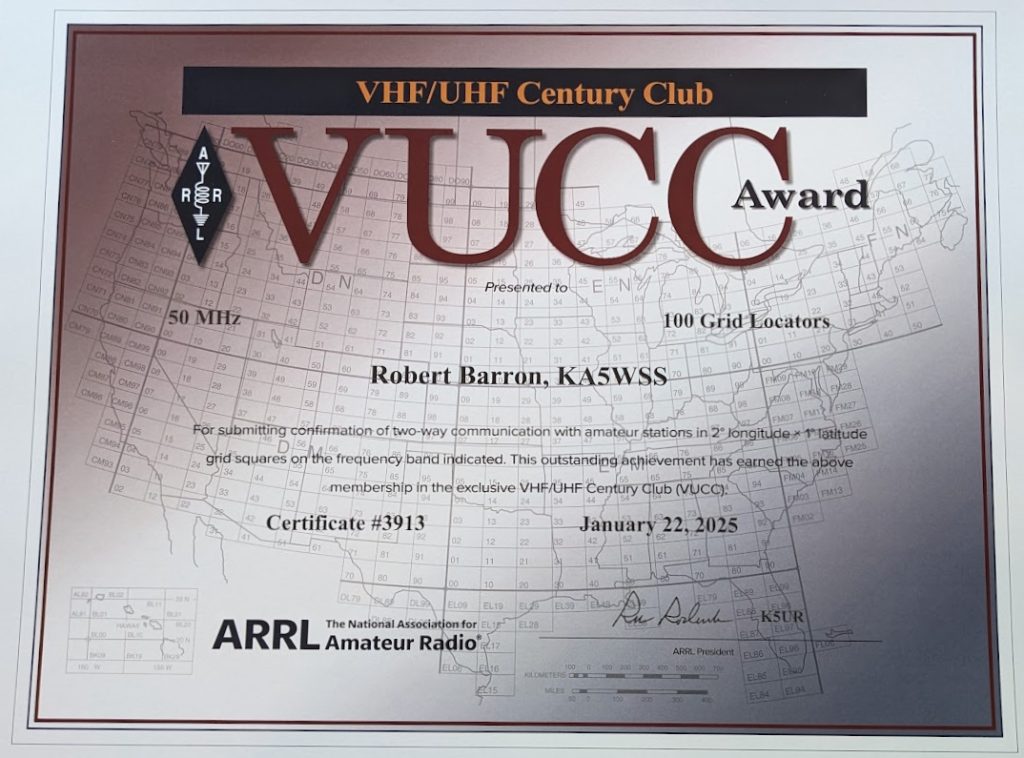
The VHF/UHF Century Club (VUCC) is the world’s premier VHF/UHF operating award. The American Radio Relay League (ARRL) offers the award for all bands above 50 MHz (with a couple of exceptions noted below).
The requirements for VUCC vary widely depending upon the band in question. The lower VHF bands requires contacts with stations in 100 different grids. This provides the source for “century” in the award name. The number of grids required falls dramatically as frequencies rise due to more limited terrestrial propagation. See the table on the right for details.
| Bands | Required Grids |
| 50 MHz, 144 MHz, Satellite | 100 |
| 222 MHz, 430 MHz | 50 |
| 902 MHz, 1.2 GHz | 25 |
| 2.3 GHz | 10 |
| 3.3 GHz and above | 5 |
There are a few VHF bands that VUCC does not cover since they are not allocated to Amateur Radio operators in the United States. These include the 8M (40 – 45 MHz), 5M (58 – 60.1 MHz) and 4M (70 – 70.5 MHz) bands. You’ll have to look elsewhere to chase awards for them.
You can obtain endorsement stickers for working additional grids. The increments vary from every 5 to 25 grids depending upon the band. There are no endorsements or separate awards for using a single mode.
The easiest method of applying for VUCC is through the ARRL’s Logbook of The World (LoTW) system. After uploading your contacts to LoTW, once they are matched up with similar log entries from other stations the LoTW system allows you to apply for the award electronically without the need to submit any physical cards for checking.
The price of award varies depending on the number of QSOs included in the application, whether you are a member of the ARRL or live outside the US. For a 50 MHz award with 100 contacts the starting point to get a certificate is around $30. Refer to the latest VUCC rules for more details.